for builders

Know the site before you price it.

Read the site in Properties before you price it. Planning gets the pack to lodging, Marketplace brings the quotes, Project Management holds the job.

Already have an account? Sign in

You're pricing a job off an address you haven't walked, with a planning pack that isn't finished and three trades who all said they'd call back. That's a Tuesday. Put the address in and you'll have the zoning, the overlays and the likely approval path before you commit to the drive out there. The pack comes together in one place instead of five inboxes, and when it's ready you lodge it yourself on the NSW Planning Portal. Urban Pulse doesn't lodge it for you and can't promise you an approval. Then you invite the trades you actually want, compare what they've quoted, and the job keeps its own record while you run it.

Urban Pulse is an Australian construction platform: site intelligence, town planning, contractor marketplace, Send & Sign, and project management in one workspace.

Price the job before you walk the site

Half of a bad price is a site nobody read. Put the address in and you'll get the zone, what the council allows on it, the overlays sitting over it and the likely approval path, in plain English. Do that before you give up a day to the drive and the measure-up, and well before you hand a client a number you'll have to walk back.

If we can't match the address to a property you get nothing back: no zone, and no default figure to price against. If it matches but your council's own controls aren't mapped, what comes back is the state scheme's default, labelled as that rather than dressed up as your council's schedule. Any overlay layer we didn't read is listed as Not checked. Not checked is a job for you, not an all-clear.

Where the controls are mapped, the read goes past the zone. Maximum height, maximum storeys, front, side and rear setbacks, maximum site coverage, minimum garden area, car parking. Path Advisor names the likely route, complying development, a development application, or exempt, and what would tip the job into a full DA. When a client wants it written down before they commit, a Preliminary Planning Investigation is the written read of the site.

Get the planning pack away without chasing it

Planning assembles the development application pack out of what you and your consultants supply and hands it back as a PDF that is ready to lodge. One version, and it is the current one. You lodge it yourself on the NSW Planning Portal and mark it as lodged here, so the rest of the job can see where it stands without ringing you.

Urban Pulse doesn't lodge on your behalf and doesn't promise an approval. That's the council's call. What it takes off you is the assembly, the chasing, and the third round of working out which set of drawings is the latest.

Invite the trades you actually want

Marketplace runs on invitations. You choose who quotes, they quote, you compare, you award. Nothing goes to a board and nobody you didn't ask turns up.

Each trade's licence, insurance and ABN are recorded on their profile, so you read them next to the number instead of digging them out after you've already decided. Recorded is not the same as checked against a register. It shortens your diligence, it doesn't stand in for it, and you still make your own checks before you award.

Keep the record the client will ask for

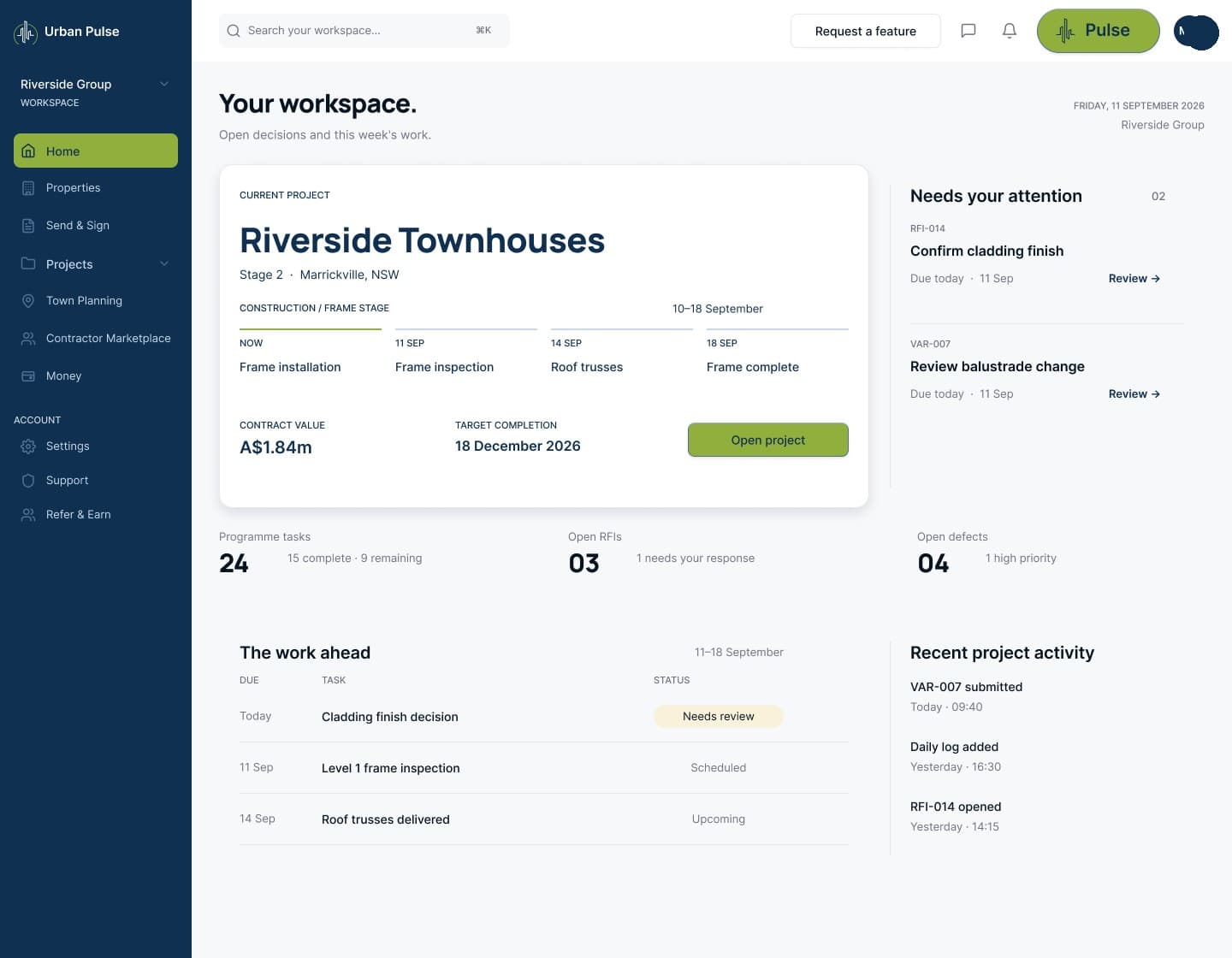
Once the work's awarded, Project Management holds the programme and the milestones, the daily log, the photos, every variation as it's raised, the defects and the RFIs. One job record instead of a group chat. The day something is argued about, the dates are already written down.

Claims and retention are modelled here too: the state of a claim, what's held, when it releases. None of that moves money. A person authorises any release.

what changes for you

From a phone-call price to a read site

Same job, same council. What changes is that you're no longer the only person holding it all together in your head.

Read the site before you price

Put an address in and get the zone, what the council allows, the overlays we read and the likely approval path, without the planning codes.

A pack that is ready to lodge

Planning assembles the development application pack from what you supply and hands it back as a PDF. You lodge it on the NSW Planning Portal.

Invite the trades you choose

You pick who quotes, they price the work, you compare and you award. Nothing goes to a board.

Credentials recorded beside the quote

Licence, insurance and ABN sit on each profile so you read them next to the number. Recorded is not checked against a register, so your own checks still stand.

Get the document signed

Send a quote, contract, variation or report. Your client opens a private link, reads it and signs on the same page, with no account to create.

One record for the whole job

Programme, variations, defects, RFIs and the daily log on the same job record, written down as they happen.

how it works

Address to handover, in the order a build runs

step 1

Read the site

You put the address in. The zone, the overlays and the likely approval path come back, and you have not left the office yet.

step 2

Assemble the pack

Planning builds the development application pack out of what you and your consultants supply, and hands it back ready to lodge.

step 3

Lodge it yourself

You lodge on the NSW Planning Portal, then record it here so the job carries its own status from that point on.

step 4

Invite and award

Invite the trades you want, read their recorded licence and insurance beside the number, compare and award.

step 5

Run the build

Project Management holds the programme, the variations, the defects, the RFIs and the daily record.

the broken process is the enemy, never the people

The same job, without the chase

Pricing off an address nobody has read, then walking the number back.

The zone, the overlays and the likely path in front of you before you quote.

A pack chased across five inboxes, with nobody sure which set is current.

One pack, one current version, and the lodgement recorded against the job.

Picking a trade off a phone call and hoping the paperwork is current.

Invited quotes with licence, insurance and ABN recorded beside each number.

questions we get asked

What builders ask

What do I actually get back for an address?

The zone and its name, what the council allows there, the overlays we read and the likely approval path. Where the controls are mapped you get the envelope with it: maximum height, storeys, setbacks, site coverage, garden area and parking. Figures taken from the state scheme's default are labelled as that.

Does Urban Pulse lodge the development application?

No, you do. Planning assembles the pack from what you and your consultants supply and gives it to you as a ready-to-lodge PDF. You lodge it on the NSW Planning Portal and mark it as lodged here, so the job shows where it sits. No approval outcome is promised by anyone on this platform.

How do trades end up on my job?

You invite them, one invitation at a time. You choose who quotes, they price it, you compare and you award, and nothing is broadcast to a board. Licence, insurance and ABN sit recorded beside each quote, and you still make your own checks before you hand over the work.

Can I get the contract signed through Urban Pulse?

Yes. Send & Sign carries quotes, contracts, variations and reports. Your client opens a private link, reads the document and signs on the same page, with no account to create at their end. You can see whether it's been opened and signed without ringing to ask.

Which states can I check a site in?

Seven: New South Wales, Victoria, Queensland, Western Australia, South Australia, Tasmania and the ACT. Price a New South Wales job and the mapped overlays come back with it, which happens nowhere else yet. Queensland jobs read against that council's own rules. The Northern Territory is not live.

people also ask

People also ask

How do builders check what a site allows before quoting?

On Urban Pulse, a builder enters the address and Properties returns the zone and zone name, what the council allows, the overlays it read and the likely approval pathway, drawn from live state planning data. Where the controls are mapped it also returns the envelope: height, storeys, setbacks, site coverage, garden area and parking. It is site information, not planning advice.

Can a builder invite specific trades to quote instead of posting the work?

Yes. Marketplace on Urban Pulse works by invitation: the builder picks the trades who quote, compares what comes back, and awards the job. There is no open board and no lead is sold to anyone. Each trade's licence, insurance and ABN are recorded on their profile, and the builder still makes their own checks.

Does a builder have to lodge a development application themselves?

On Urban Pulse, yes. Planning assembles a ready-to-lodge development application pack as a PDF, and the customer lodges it on the NSW Planning Portal and records the lodgement against the job. Urban Pulse does not lodge for anyone and does not promise an approval outcome.

Know the site. Then price it.

One work email, and that's the lot. No account, no organisation and no plan is created by this, and we'll tell you when you can read a site, get a pack together and invite the trades you want.

Already have an account? Sign in